Showing posts with label hebrew. Show all posts

Monday, April 25, 2011

Spirit not Mechanics

'Learning' Hebrew is not like learning any other language and it's NOT memorization. It's truly immersing your spirit in this heavenly language - awakening the Holy language within your spirit. So it is spirit not mechanics.

Gen 1:1-3 "In the beginning God created the heavens and the earth. The earth was without form, and void; and darkness was on the face of the deep. And the Spirit of God was hovering over the face of the waters. Then God said, 'Let there be Light' and there was Light."

Hebrew is the language Adonai spoke when He created the heavens and the earth…powerfully displaying the creative power of the Word. Hebrew is the language He spoke to Adam – who partnered in naming animals, spoke to Eve (Chavah, referred to as mother of all living, lifegiver), Noah and others in those generations… unlike any other ‘religion’ the Torah alone shows that every Jewish man, woman, and child alive in 1312 B.C.E. — about three million people, according to the Torah — heard God speak at Mount Sinai and survived to teach their descendants about the event. As Yeshua is the Word (Torah) made flesh...we are becoming the same and so immersing in Torah, in Hebrew, is the L-rd transforming our physical flesh into Torah flesh.
A great site to glean from: http://www.hebrew4christians.com/
Print this: http://www.hebrew4christians.com/Grammar/Unit_One/Aleph-Bet/Alphabet.pdf
and write each letter over and over...that is part of how you can flesh out those Holy letters that are written on your heart - hand, heart, eyes all being involved in the process.

Monday, January 24, 2011

Immersing in Hebrew: deep calls unto deep, Psalm 42

Psalm 42: 8-9
"Deep calls unto deep at the noise of Your waterfalls; All Your waves and billows have gone over me. The LORD will command His lovingkindness in the daytime, And in the night His song shall be with me—A prayer to the God of my life."
The word translated here as 'waterfalls' is actually צִנּוֹרֶיךָ tzinoreeka which means 'cataracts' : a descent of water over a steep surface; a waterfall, esp.one of considerable size; any furious rush or downpour of water; deluge.

deep to deep calls
תְּהוֹם-אֶל-תְּהוֹם קוֹרֵא
tehome el tehome koreh

of the sound Your cataracts
לְקוֹל צִנּוֹרֶיךָ
l'kole tzinoreeka

The LORD will command His lovingkindness in the daytime, And in the night His song shall be with me— A prayer to the God of my life.
יוֹמָם, יְצַוֶּה יְהוָה חַסְדּוֹ, וּבַלַּיְלָה, שִׁירֹה עִמִּי
תְּפִלָּה, לְאֵל חַיָּי
yo·v·mam ye·tzav·veh ha·shem chas·dov u·val·lay·lah ch shi·rah k shi·rov im·mi te·fil·lah le·'el chai·yai.

Saturday, January 22, 2011

Immersing in Hebrew...Parshah Yitro: Shabbat

Even if you 'know' only a few words in the passage below...with the English/Hebrew and transliteration, you will probably be able to figure out word meanings and that is one of the best ways to awaken Hebrew in your spirit...just dive in.

Exodus 20:8-11 from Parashah Yitro (Torah Portion Jethro)

8 “ Remember the Sabbath day, to keep it holy. 9 Six days you shall labor and do all your work, 10 but the seventh day is the Sabbath of the LORD your God. In it you shall do no work: you, nor your son, nor your daughter, nor your male servant, nor your female servant, nor your cattle, nor your stranger who is within your gates. 11 For in six days the LORD made the heavens and the earth, the sea, and all that is in them, and rested the seventh day. Therefore the LORD blessed the Sabbath day and hallowed it.

8 Remember the sabbath day, to keep it holy.
זָכוֹר אֶת-יוֹם הַשַּׁבָּת, לְקַדְּשׁוֹ.

za·cho·vr et-yo·vm ha·shab·bat le·kad·de·shov

9 Six days you shall labor and do all your work

שֵׁשֶׁת יָמִים תַּעֲבֹד, וְעָשִׂיתָ כָּל-מְלַאכְתֶּךָ.

she·shet ya·mim ta·'a·vod ve·'a·si·ta kol-me·lach·te·cha.

10. but the seventh day
is the Sabbath of the LORD your God. In it you shall do no work: you, nor your son, nor your daughter, nor your male servant, nor your female servant, nor your cattle, nor your stranger who is within your gates.

וְיוֹם, הַשְּׁבִיעִי--שַׁבָּת, לַיהוָה אֱלֹהֶיךָ: לֹא-תַעֲשֶׂה כָל-מְלָאכָה אַתָּה וּבִנְךָ וּבִתֶּךָ, עַבְדְּךָ וַאֲמָתְךָ וּבְהֶמְתֶּךָ, וְגֵרְךָ, אֲשֶׁר בִּשְׁעָרֶיךָ.

ve·yo·vm ha·she·vi·'i shab·bat la·shem e·lo·hei·cha lo-ta·'a·seh chol-me·la·chah at·tah u·vin·cha-u·vit·te·cha av·de·cha* va·'a·ma·te·cha* u·ve·hem·te·cha ve·ge·re·cha a·sher bish·'a·rei·cha.

11. For in six days the LORD made the heavens and the earth, the sea, and all that is in them, and rested the seventh day. Therefore the LORD blessed the Sabbath day and hallowed it.

כי שֵׁשֶׁת-יָמִים עָשָׂה יְהוָה אֶת-הַשָּׁמַיִם וְאֶת-הָאָרֶץ, אֶת-הַיָּם וְאֶת-כָּל-אֲשֶׁר-בָּם, וַיָּנַח, בַּיּוֹם הַשְּׁבִיעִי; עַל-כֵּן, בֵּרַךְ יְהוָה אֶת-יוֹם הַשַּׁבָּת--וַיְקַדְּשֵׁהוּ.
ki she·shet-ya·mim a·sah ha·shem et-ha·sha·ma·yim ve·'et-ha·'a·retz et-hai·yam ve·'et-kol-a·sher-bam vai·ya·nach bai·yo·vm ha·she·vi·'i al-ken be·rach ha·shem et-yo·vm ha·shab·bat vay·kad·de·she·hu.

Tuesday, January 18, 2011

immersing in Hebrew: Yitro - 2 verses

This week's Torah portion: Yitro

Here are the first two verses - If you are learning Hebrew, a beautiful way to learn is sound out the Hebrew words, compare to the transliteration and then often figuring out the meaning is easy. Meaning or not...the language itself will course through your soul.

Exodus 18: 1
And Yitro, the priest of Midyan, Moshe's father-in-law, heard of all that G-d had done for Moshe and for Yisrael His people--that HASHEM had brought Yisrael out of Egypt.

א וַיִּשְׁמַע יִתְרוֹ כֹהֵן מִדְיָן, חֹתֵן מֹשֶׁה, אֵת כָּל-אֲשֶׁר עָשָׂה אֱלֹהִים לְמֹשֶׁה, וּלְיִשְׂרָאֵל עַמּוֹ: כִּי-הוֹצִיא יְהוָה אֶת-יִשְׂרָאֵל, מִמִּצְרָיִם.

Vayishma Yitro chohen Midyan choten Moshe et kol-asher asah Elokim le-Moshe ule-Yisrael amo ki-hotzi HASHEM et-Yisrael miMitzrayim.

2. Moshe's father-in-law, Yitro took Moshe's wife, Tziporah, after he had sent her back [home],

ב וַיִּקַּח, יִתְרוֹ חֹתֵן מֹשֶׁה, אֶת-צִפֹּרָה, אֵשֶׁת מֹשֶׁה--אַחַר, שִׁלּוּחֶיהָ.

Vayikach Yitro choten Moshe et-Tziporah eshet Moshe achar shilucheiha.

Thursday, December 23, 2010

Aaronic Benediction & Spock's Vulcan Salute

Numbers 6: 22-27

22 And the LORD spoke unto Moses, saying:

23 'Speak unto Aaron and unto his sons, saying: On this wise ye shall bless the children of Israel; ye shall say unto them:

24 The LORD bless thee, and keep thee;

יְבָרֶכְךָ יְהוָה, וְיִשְׁמְרֶךָ.
Y’-varechec
ha Adonai v’yish-marechah.

25 The LORD make His face to shine upon thee, and be gracious unto thee;

יָאֵר יְהוָה פָּנָיו אֵלֶיךָ, וִיחֻנֶּךָּ.

Ya-air Adonai
panav alechah veechu-nechah.

26 The LORD lift up His countenance upon thee, and give thee peace.

יִשָּׂא יְהוָה פָּנָיו אֵלֶיךָ, וְיָשֵׂם לְךָ שָׁלוֹם.
Yisa
h Adonai panav alechah v’ya-sem l’chah shalom.

27 So shall they put My name upon the children of Israel, and I will bless them.'

audio and more details about the blessing

Ted Pearce, Aaronic Benediction

a great song to learn the blessing - visit Ted's site

So yes Spock got his vulcan salute from the priestly blessing

Wednesday, December 15, 2010

Hebrew Links

To help to awaken Hebrew within your heart...Hebrew posts on this blog

http://translate.google.com/ actually a pretty good, basic translator, if accuracy is importance, don't rely on this however

www.interlinearbible.org/ an ok English/Hebrew/transliterated Bible - for vav uses ‘w’ sound instead of ‘v’

Hebrew words are based on 2 or 3 letter root words
Hebrew Word Roots: http://www.jewfaq.org/root.htm

Sunday, November 30, 2008

flame-carved commandments

Disclaimer: I apologize for the meandering nature of this post. But as G-d is so uncontainable, I found it difficult to condense and contain these ideas into a neat package but hope this wandering is thought-provoking...

I know the verse:

Deuteronomy 9:10 Then the LORD delivered to me two tablets of stone written with the finger of God, and on them were all the words which the LORD had spoken to you on the mountain from the midst of the fire in the day of the assembly. (NKJV)

and so I assumed that literally the 10 Commandments were "written by the finger of G-d." But Ad-nai is a consuming Fire...

Deuteronomy 5:24-25 And you said: ‘Surely the LORD our God has shown us His glory and His greatness, and we have heard His voice from the midst of the fire. We have seen this day that God speaks with man; yet he still lives. Now therefore, why should we die? For this great fire will consume us; if we hear the voice of the LORD our God anymore, then we shall die. (NKJV)

Hebrews 12:28-29 Therefore, since we are receiving a kingdom which cannot be shaken, let us have grace, by which we may serve God acceptably with reverence and godly fear. For our God is a consuming fire. (NKJV)

and the Hebrews literally saw that fire many times:

Exodus 20:18-19
And all the people are seeing the voices, and the flames, and the sound of the trumpet, and the mount smoking; and the people see, and move, and stand afar off, and say unto Moses, 'Speak thou with us, and we hear, and let not God speak with us, lest we die.'(JPS)


Did you ever notice that the people are "seeing voices"? Here's a more literal translation:

Exodus 20:18-19 And all the people saw6 the thunderings, and the lightnings, and the noise of the trumpet, and the mountain smoking: and when the people saw4 [it], they removed,4 and stood4 afar off. (KJV with links to Hebrew words and meaning)

Thunderings = voices; lightning= flames. If we read this account as merely words talking about some historic event or even worse, if we question that this event actually happened, we are missing the awesomeness of G-d. If the Bible is Truth, the details of this event Truly happened, as impossible as they may seem. But back to fire...this verse amazed me:

Psalms 29:7 The voice of the LORD divides the flames of fire. (NKJV)

or a more closer translation...

Psalm 29:7
The voice of HaShem heweth out flames of fire. (JPS)


The word hew in Hebrew is chatsab חֹצֵב which means to cut, carve, hew...divide, which the KJV uses. Jewish tradition teaches that, one by one, the commandments were written by flame as the people said "yes we will obey." So could it be that Ad-nai wrote the Commandments with flames of fire, carving His Word into stone, preparing to lovingly sear His Word in our hearts (Jer 31:33),and He does so as we receive what He gives us? Makes G-d-sense to me!

Jeremiah 31:33 "'This is the covenant I will make with the house of Israel after that time,' declares the LORD. 'I will put my law in their minds and write it on their hearts. I will be their God, and they will be my people.'"

I wonder if the word division in Hebrews 4:12, had it been written in Hebrew, would be chatsab?

Hebrews 4:12
For the word of God is living and powerful, and sharper than any two-edged sword, piercing even to the division of soul and spirit, and of joints and marrow, and is a discerner of the thoughts and intents of the heart. (NKJV)

This Hebrew translation of the Brit Chadashah uses chatsab in Hebrews 4:12.

By the way, the 10 Commandments are just a shortened version of the Torah and the Torah is the Word and the Word is Yeshua, Jesus, the Messiah. So to really encapsulate the ideas in this post: Yeshua is a consuming fire that dwells in our hearts causing us to be like Him to show His Glory.

Thursday, November 27, 2008

G-d's appointed times: lost in translation

Because the meanings within the Hebrew language are multi-layered, familiarity with even a little Hebrew can deepen our understanding of G-d’s Word. Since we’ve just walked through a number of Ad-nai’s festivals, here’s a perfect example of G-d’s love, beauty and Truth inherent in the language that gets lost in English translation: “Then God said, “Let there be lights in the firmament of the heavens to divide the day from the night; and let them be for signs and seasons, and for days and years’” (Genesis 1:14 NKJV).
The Hebrew word for seasons is Moadim מוֹעֲדִים which means appointed or set times, as in “let us celebrate the moadim,” “let us celebrate the appointed times.” What’s the big deal? “Seasons” are equated with 12 months broken into 4 parts (summer, winter, spring, and fall), not specifically “set times,” which Ad-nai details in Leviticus 23 and all throughout Scripture.

In the beginning, G-d said…everything we need to know, but unfortunately so much Truth has been forgotten, hidden, or twisted by the world. But Ad-nai is revealing what has been hidden for so long that we would be prepared for this: “The hour is coming, and now is, when the true worshipers will worship the Father in spirit and truth; for the Father is seeking such to worship Him. God is Spirit, and those who worship Him must worship in spirit and truth” (John 4:23-24, NJKV).

Like the Torah, the Living Word, the Hebrew language is a living language, the only truly living language. And though Hebrew lay dormant for centuries when it was only spoken by a small number of religious Jews, it has re-emerged as a vibrant, breathing, powerful language that Ad-nai is drawing out from within His people to glorify Himself. Learning Hebrew is not just about words and letters. Like everything else Ad-nai has created, it’s really about His Amazing love and the little gifts He graces us with, some wrapped in jots & tittles (Matthew 5:18), gifts of Himself.

Here's a side by side Hebrew/Engish Bible site.

Wednesday, November 26, 2008

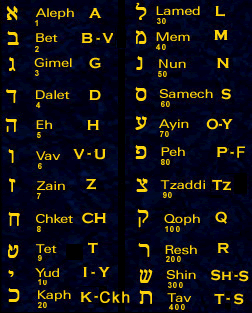
the Hebrew alephbet

The Hebrew Alephbet consists of 22 letters, all consonants. Most of these letters sound like the letter name. For example, the letter Mem מ is pronounced like an M, as in Moadim, which means appointed times. Of these 22 consonants, there are 2 silent letters that can take on different sounds, mainly for vowels. Vowel markers, small symbols near a letter, are also added for clarity in some Hebrew writing. Hebrew is read from right to left, which takes a little time to get used to. But when thinking about learning Hebrew, realize just like Torah, we are not in a race to acquire head knowledge; we are in a process of spiritual growth, allowing Ad-nai to birth within us what He has for each of us, each part of the body.

The name AlephBet comes from the first two letters of Hebrew: Aleph and Beit, similar to the English AlphaBet based on the first two Latin letters, Alpha and Beta. But that is one of the very few similarities to English because Hebrew has so many more levels of meaning compared to the English language. To some degree we can describe Hebrew much like we describe Ad-nai: simple yet amazingly and beautifully complex. For example, our letter B has no meaning aside from the fact that it sounds like “bee.” In Hebrew every letter has its own meaning(s), which then combines with other letters to make up the meaning of a word or phrase. Confusing? Here’s an example: El is a simple name for G-d. In Hebrew it is spelled אל - the letters Aleph Lamed. Ancient Hebrew letters were written as pictures based on the meaning of the letter. Aleph looks like the head of a bull - representing strength, and is often said to represent G-d. Lamed looks like a staff . And so when you say the “little” word El, realize you are saying something very “big” - The L-rd is my Shepherd!

Hebrew4Christians is a great site to begin to learn Hebrew.

Thursday, December 6, 2007

Hanukkah day 3 lighting, Torah reading, Parashat Miketz

Hanukkah Day 3 Torah Portion: Numbers 7:24 - 7:35

Lighting the menorah and blessings

And the weekly torah portion for this Shabbat is Parashat Miketz (“at the end of”)

Dec 8, 2007 Kislev 28, 5768 Chanukah

Miketz
Gen 41:1-44:17
1Kings 3:15-4:1
Rom 10:1-13

This is my first year celebrating Hanukkah and so far I have learned so much. I never knew the origin of Hanukkah; truthfully, I never thought it mattered to me. Honestly, I might have rolled my eyes at Hanukkah being paralleled with Christmas. I didn't see any personal connection to the Jewish people as a non-Jew and I saw no collective connection as a believer in Christ. And some ignorant part of me thought the Jews should wisen up and just celebrate Christmas! But now as I am beginning to understand and embrace our Hebraic roots, I confess my ignorance. Now, I do feel that connection, moreso a need and a purpose for a connection.

The Jewish people are a light to the world, a light God called to glorify Him, that all nations would come to Him. The Jewish people have preserved our (1) Scriptures, (2) the way God directed them to live in the Torah and (3) the festivals God-ordained (and Hanukkah which was not commanded by God, but set apart for Him).

Though Christianity's ways, so to speak, differ, these "ways" would be without any resemblance to the One, True God without the commitment, loving devotion, and determination of the Jewish people. Over the centuries, millions of Jews have given their lives to preserve the Holiness of God and all that that entails and to bring forth Yeshua the Messiah, a descendant of Abraham, the first Hebrew. So to them, His chosen people, I am forever grateful.

Monday, November 5, 2007

who preserved the "Christian" Bible?

Answer: the Jewish people.

Roughly 2/3 of the Bible is the Hebrew Scriptures (aka Old Testament or in Hebrew: TANAKH) which was meticulously maintained by the Jewish people, namely the scribes. Plus the people who protected it by hiding it, burying, and in so doing, often risking their lives. Read more below.

Photo: torah scroll saved in nazi germany | more information


Links
Process of copying the Old Testament by Jewish Scribes
How was the Old Testament Preserved

Thursday, October 11, 2007

Instructions not Law

This bears repeating: Torah means "teaching" or "instruction", not Law. Believers in Yeshua who closely study and folllow Torah do not do so to earn salvation or attempt to be "right" in God's eyes. We can never be right in God's eyes without the Messiah.

Closely studying The Hebrew Scriptures greatly increases understanding and appreciation of the New Testament because Torah is the foundation of the entire Bible. Following Torah can bring a believer into a deeper, more personal relationship with God because he or she is living as God instructed His people to live, even before He designated people as Hebrews: Adam, Eve, Cain, Abel, Noah . . .

Consider this article: Is the Torah in Force Today? by Brian Stephens

Sunday, September 9, 2007

the Law or the Prophets

Matthew 5:17 "Do not think that I have come to abolish the Law or the Prophets; I have not come to abolish them but to fulfill them." (NASB)

What does "the Law or the Prophets" refer to? The Hebrew word for the Old Testament is the Tanakh which is divided into 3 parts:

(1) T: the Law (Torah - Genesis, Exodus, Leviticus, Number, Deuteronomy)

(2) N: the Prophets (Nevi'im - any books related to the prophets, e.g. I & II Samuel, Isaiah, Ezekiel, Jeremiah)

(3) K: the Writings (Ketuvim - books related to history, wisdom & poetry, e.g. Psalms, Proverbs, Job, Ruth Esther)

So when Jesus refers to the Law or the Prophets, He was referring to the Scriptures that were in existence at the time of and before His birth. It could easily be written: "I did not come to abolish the Tanakh" or "I did not come to abolish the Hebrew Scriptures."

And whenever "the Law" is mentioned (and notice that it's mentioned many times throughout the Bible), it can rightly be concluded that "the Law" could more accurately be written "Torah."

Shanah Tovah!

Friday, September 7, 2007

Jesus, the Walking Torah?

Jews and Christians have been historically divided for centuries. The main reason for that division is obviously the Christian belief in Jesus as Messiah, what amounts to the Trinity which we'll get to later. But another huge difference is the strong belief, on both sides, that believers in Jesus are not expected to live by Torah. Interesting contradiction when you consider that Torah is a good chunk of the Word of God, right?

And consider that God "spoke" the creation into being (Genesis 1) and that Jesus was the Word: John 1: 14 ~ "And the Word became flesh, and dwelt among us, and we saw His glory, glory as the only begotten from the Father, full of grace and truth." (NASB)

The whole thing can be summed up in John 1:1 ~ "In the beginning was the Word, and the Word was with God, and the Word was God." But what part of the Word was John referring to? When Jesus and John referred to the Word, there was no New Testament. There was only the Old Testament, as Christians call it, or the Tanakh, as Jews refer to it--or more simply, the Hebrew Scriptures. The Bible says the Word is literally God Himself and Jesus was basically the walking Word. Could we say Walking Torah? Or is the "New Testament" simply a thoughtful, gentler revision of the "Old Testament"?

And so can we rationally say that the "New Testament" (roughly 1/3 of the Scriptures) basically replaces the "Old Testament" as far as in how we live our daily lives? If we believe that the Torah is not for Christians, then that is basically what we are saying. The Word has changed or has it?